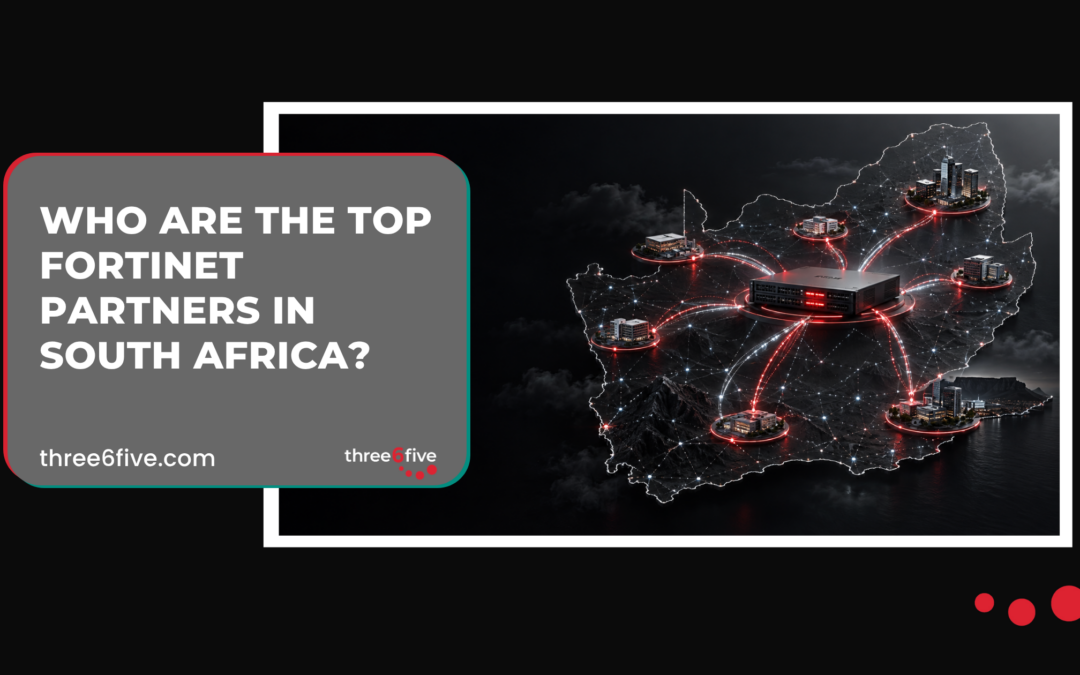
Who Are the Top Fortinet Partners in South Africa?

Who Are the Top Fortinet Partners in South Africa?

South Africa has several highly capable Fortinet partners, but they are not all built for the same job.

Some specialise in very large enterprise and government projects. Others are particularly strong in industrial security, telecommunications or managed security operations. Then there are specialist partners such as three6five, where networking, security and day-to-day infrastructure operations are treated as one connected environment.

Based on their technical capabilities, market presence and suitability for different requirements, five of the leading Fortinet partners in South Africa are NEC XON, BCX, Datacentrix, Vodacom Business and three6five.

The short answer

There is no single “best” Fortinet partner for every South African organisation. The right choice depends on your industry, geographic footprint, technical complexity and the level of engineering support you expect after implementation.

This is not a league table. Bigger does not automatically mean better, and neither does having the longest list of certifications on a slide deck. The best Fortinet partner is the one with the right engineering capability, operating model and experience for your environment.

Fortinet partnership tiers, specialisations and individual certifications can change. Before appointing a provider, confirm its current status through the official Fortinet Partner Locator.

What does a Fortinet partner actually do?

A Fortinet partner can help an organisation design, implement, license and support technologies from the Fortinet Security Fabric.

Depending on the partner’s capabilities, this may include:

✓FortiGate Next-Generation Firewalls

✓Fortinet Secure SD-WAN

✓Network segmentation and secure remote access

✓Cloud and hybrid network security

✓Firewall policy and configuration management

✓Ongoing managed network and security services

The difference between partners becomes apparent when things get complicated. Installing a firewall at one office is very different from standardising security across 100 branches, multiple connectivity providers, cloud environments and inherited networks.

That is where architecture, routing expertise, monitoring and access to experienced engineers begin to matter.

Who are the leading Fortinet partners in South Africa?

1. NEC XON

NEC XON is one of the most established Fortinet partners serving large organisations in South Africa and across the continent. It has the scale, engineering depth and wider infrastructure capabilities required for extensive enterprise programmes.

NEC XON is particularly strong in:

  • Operational Technology security
  • Mining, manufacturing and critical infrastructure
  • Large retail and enterprise networks
  • Integration of IT and industrial environments
  • Projects requiring a substantial technical resource pool

NEC XON has previously been recognised as Fortinet’s Most Certified Partner of the Year and has developed capabilities across several Fortinet specialisations.

Its Operational Technology experience is particularly relevant to mines, factories, utilities and similar organisations. These environments involve more than protecting laptops and business applications. The network may support machinery, production systems and critical physical operations.

Best suited to: Industrial networks, mines, factories, utilities, SCADA environments and very large infrastructure estates.

2. BCX

BCX is a major South African systems integrator with the scale to support large enterprise, government and pan-African technology environments.

Its strength lies in combining networking, connectivity, cloud, data-centre services and cybersecurity within a broad enterprise services portfolio.

BCX is particularly strong in:

  • Large government and public-sector environments
  • Major financial institutions
  • National and pan-African network footprints
  • Large Secure SD-WAN programmes
  • Complex procurement and supplier-governance requirements

BCX is suited to organisations that need a provider capable of coordinating extensive infrastructure programmes across many locations. It can integrate Fortinet security technologies into broader corporate and legacy technology environments.

Best suited to: Major government departments, multinational organisations and very large enterprises requiring support across several African countries.

3. Datacentrix

Datacentrix is a strong option for organisations that want Fortinet incorporated into a broader managed security, cloud and hybrid IT strategy.

Its capabilities extend beyond perimeter protection into security operations, modern workplace security, cloud environments and ongoing threat monitoring.

Datacentrix is particularly strong in:

  • Managed security services
  • Security Operations Centre capabilities
  • Hybrid cloud protection
  • Distributed workforces
  • Security monitoring and incident response

Datacentrix has achieved Expert Level status within the Fortinet Engage Partner Program, demonstrating its ability to support broad and technically demanding Fortinet environments.

Best suited to: Organisations requiring a broad managed Security Operations environment incorporating cloud monitoring, endpoints, SIEM and incident response.

4. Vodacom Business

Vodacom Business offers a different value proposition because it can combine telecommunications, connectivity and managed security services.

This can appeal to organisations that want fixed connectivity, mobile services and cloud-delivered security managed under one major provider.

Vodacom Business is particularly strong in:

  • Managed connectivity and security bundles
  • Large distributed workforces
  • Mobile and fixed-network convergence
  • Cloud-delivered security
  • Secure Access Service Edge environments

Best suited to: Organisations that want their Fortinet solution closely bundled with telecommunications, mobile and cloud-edge services.

5. three6five

three6five is a South African IP networking systems integrator and managed infrastructure service provider.

We approach Fortinet differently from a traditional reseller. We do not view a firewall as a box sitting at the edge of the network. It forms part of the organisation’s complete IP routing, connectivity and digital business infrastructure environment.

Our core Fortinet capabilities include FortiGate Next-Generation Firewalls, Fortinet Secure SD-WAN, complex routing, network integration and managed infrastructure support.

These technologies are deployed as part of the wider Fortinet Security Fabric, with routing, connectivity, application traffic, cloud dependencies and operational risks considered from the beginning.

Why three6five?

Our ideal customer does not simply want a firewall installed and handed over. It wants an engineering partner that understands the business behind the network and remains involved after implementation.

three6five is particularly strong in:

  • Mid-market and large multi-branch enterprises
  • Secure SD-WAN environments with approximately 20 to 150 sites
  • Complex BGP and multi-provider routing
  • Hybrid WAN and data-centre connectivity
  • Standardising networks following acquisitions
  • Proactive managed network services
  • Direct access to Tier-2 and Tier-3 engineers

three6five has previously received Fortinet’s Commercial Partner of the Year recognition. Our engineering team maintains skills aligned with Fortinet’s professional certification framework.

Best suited to: Organisations that need an agile, engineering-led Fortinet partner for complex enterprise networking, Next-Generation Firewall and Secure SD-WAN environments.

How three6five standardised and secured a major logistics network

One of our strongest real-world examples comes from the logistics, supply chain and cold-storage sector.

The client is the largest cold-storage and logistics provider in the Southern Hemisphere. It was expanding rapidly through corporate acquisitions, but every new facility introduced a different collection of inherited switches, firewalls, connectivity services, firmware versions and configurations.

On paper, it was one growing organisation. At network level, it was a collection of separate legacy environments held together by good intentions and some increasingly nervous IT teams.

The business challenge

For a cold-storage and logistics provider, network downtime is not merely an IT inconvenience. Inventory management, warehouse operations, Quality Assurance and cold-chain tracking all depend on reliable data movement.

The inherited environments created several risks:

  • Limited visibility across newly acquired facilities
  • Inconsistent firewall and network configurations
  • Outdated firmware and unmanaged equipment
  • Configuration drift between locations
  • Unpredictable connectivity failures
  • Potential disruption to operational and quality-control systems

The Fortinet solution

three6five developed a consolidation and modernisation strategy using FortiGate Next-Generation Firewalls and Fortinet Secure SD-WAN.

FortiGate firewalls established consistent perimeter protection across the expanding environment. Secure SD-WAN connected the distributed facilities through a unified, secure and intelligently routed architecture.

The infrastructure was then integrated into the three6five Network Operations Centre. Our monitoring extends beyond checking whether a device responds to a ping.

Telemetry, NetFlow, SNMP and configuration monitoring help identify:

  • Link flapping
  • CPU and resource spikes
  • Unexpected configuration changes
  • Interface failures
  • Connectivity degradation
  • Security events

The result

Instead of allowing every acquisition to remain a separate legacy environment, each facility could be assessed against an agreed technical roadmap.

Infrastructure was modernised systematically or replaced where the operational risk was too high. This created a more consistent, visible and supportable network estate.

The practical lesson

Secure SD-WAN is not simply a cheaper way to connect branches. When designed properly, it becomes a platform for standardising security, improving visibility and integrating newly acquired businesses.

What makes three6five different from other Fortinet partners?

We start with the network, not the product

A firewall cannot be designed effectively without understanding the traffic it must protect.

Our approach to cybersecurity and network protection starts with understanding the organisation’s routing, applications, connectivity, failover requirements, cloud dependencies and operational workflows.

This is especially important in environments involving BGP, multiple internet providers, MPLS, hybrid cloud services or complicated branch connectivity.

We tailor the architecture

Generic configurations may be quick to deploy, but they do not necessarily reflect how the organisation operates.

Our discovery process maps technical standards to actual business dependencies. This creates consistency without pretending that every branch has identical users, systems and risks.

Our NOC looks beyond uptime

Basic monitoring tells you whether a device is online. That is useful, but it does not tell you whether the environment is healthy.

Link instability, recurring errors, unusual resource utilisation and configuration changes can warn of a developing problem before a full outage occurs.

Our goal is to identify those signals while the issue is still manageable, rather than waiting for users to report that an entire branch has gone offline.

Customers can reach experienced engineers

Complex incidents should not spend days travelling through layers of non-technical escalation.

three6five’s background in carrier and enterprise IP networking allows difficult firewall, routing and connectivity problems to be escalated to experienced Tier-2 and Tier-3 engineers.

This is valuable for internal IT teams that want to collaborate with their service provider rather than disappear into a ticket queue.

How should you choose a Fortinet partner?

Partner status matters, but it should not be the only deciding factor. Before appointing a Fortinet provider, ask the following questions.

1. Has the partner delivered comparable projects?

Ask for experience involving organisations with a similar number of sites, users and technical dependencies. A firewall deployment at one office does not necessarily prove that a provider can manage a 100-site Secure SD-WAN transformation.

2. Who will design and support the environment?

Establish whether you will have access to experienced engineers or whether communication will pass through a general call centre. Ask who handles complicated incidents and how quickly senior technical resources become involved.

3. What will be monitored?

A credible managed service should monitor more than basic device availability. Ask how the provider handles performance, connectivity, security events, configuration changes, capacity concerns and recurring faults.

4. How will configuration drift be prevented?

Multi-site environments gradually become inconsistent when changes are not recorded, controlled and audited. Your partner should explain how it backs up configurations, manages changes and identifies deviations from agreed standards.

5. What happens after implementation?

Clarify whether the engagement ends at handover or includes monitoring, optimisation, lifecycle management and regular technical reviews.

The long-term quality of a Fortinet environment depends as much on its ongoing management as it does on its original design.

Warning signs when evaluating a Fortinet partner

Be cautious if a potential provider:

  • Recommends hardware before conducting proper discovery
  • Cannot provide examples of comparable projects
  • Focuses on discounts and licensing rather than architecture
  • Treats the firewall separately from routing and connectivity
  • Cannot clearly explain its escalation process
  • Provides only basic ping or availability monitoring
  • Does not have a structured change-control process
  • Cannot identify the engineers who will deliver the project
  • Makes unrealistic promises of zero downtime or absolute security

A capable partner should be willing to discuss trade-offs and risks. It should also be honest when another provider is better suited to a particular requirement.

For a deeper evaluation, read our guide on how to identify the warning signs of an ineffective infrastructure partner.

Frequently asked questions

Who is the best Fortinet partner in South Africa?

There is no single partner that is best for every organisation. The right choice depends on your industry, network size, geographic footprint, internal capabilities and support requirements.

What is Fortinet Secure SD-WAN?

Fortinet Secure SD-WAN combines intelligent WAN routing with integrated security. It enables organisations to manage traffic across multiple connectivity services while applying consistent security policies.

Does a Fortinet partner need networking experience?

Yes. Firewalls affect routing, connectivity, application performance, segmentation and business continuity. Networking expertise becomes particularly important when the environment includes BGP, MPLS, multiple service providers, hybrid cloud or complicated failover requirements.

Can three6five manage an existing Fortinet environment?

Yes. three6five can assess an existing environment, identify configuration inconsistencies, review routing and connectivity dependencies, develop a technical roadmap and provide ongoing monitoring and support.

Is three6five only suitable for mid-sized companies?

No. three6five supports mid-market and large enterprise environments. The best fit is determined by the complexity of the network and the customer’s need for direct engineering collaboration, not simply by employee count.

Choosing the right Fortinet partner

South African organisations have access to several excellent Fortinet partners. The important question is not simply, “Who is the biggest?” It is, “Who is best equipped for our environment?”

Large integrators bring scale, broad service portfolios and substantial procurement capacity. Specialist providers bring agility, direct access to senior engineers and a sharper focus on specific technical and operational outcomes.

At three6five, our strength lies in bringing IP networking, cybersecurity and managed infrastructure operations together.

Is your Fortinet environment ready for what comes next?

Whether you are planning a Secure SD-WAN transformation, replacing an inconsistent firewall estate or improving visibility across a multi-branch network, our engineers can help you find the right way forward.
Talk to a network specialist

Stop Buying Checkbox IT: Why Your Infrastructure Partner is Probably Failing You

Stop Buying Checkbox IT: Why Your Infrastructure Partner is Probably Failing You

Choosing an IT infrastructure partner is rarely just about comparing SLAs, monthly retainer costs, or response times. While these metrics are foundational, they fail to reveal the most critical variable: Does this provider actually understand your business?

A capable partner does more than monitor up/down status; they manage technical complexity, mitigate risk, and provide strategic guidance when the pressure mounts.

The real test is not what appears on the feature list. It is whether the provider can support the way your business actually works.

Ditch the Feature List

Many organizations make the mistake of selecting a provider based on a “checkbox” feature list:

✓Monitoring included.

✓Firewall management included.

✓Remote support included.

✓Monthly reporting included.

That is neat, tidy, and (unfortunately) insufficient. A feature list tells you what a provider offers; it does not explain how they think.

A robust managed infrastructure services partner should possess the technical acumen to look beyond the hardware. They should be able to identify which sites are most sensitive to latency, which applications exert the most pressure on the network fabric, and where operational bottlenecks are creating hidden risk.

That is the difference between purchasing services and gaining a strategic partner.

Real-World Reality Check: Surviving the Acquisition Avalanche

Let’s talk about what this actually looks like when the stakes are high. We recently took over infrastructure management for the largest cold storage provider in the Southern Hemisphere. This is an aggressively growing business, and with every new acquisition comes a tangled web of complex network and security requirements—usually running on chaotic, inherited legacy equipment.

When strict QA, inventory, and logistics systems are on the line, “checkbox IT” simply doesn’t survive.

For this client, we don’t just blindly support whatever we find. We ensure every newly acquired environment is seamlessly integrated into their managed infrastructure service.

We document it, map it, and make hard, immediate decisions: we either build a strategic roadmap to replace the hardware, or we completely rip and replace it on day one to meet their uncompromising operational standards.

That is what a real infrastructure partner does.

The Warning Signs: Is Your Provider Failing You?

Sometimes the need for a new partner is obvious—strained relationships and poor service. Other times, the signals are subtler:

Operational Uncertainty: If no one can clearly explain the ownership of critical systems, network dependencies, or recent configuration changes, you are operating on guesswork, not strategy.

Recurring Incidents: Every environment has isolated failures. However, if the same links, devices, or applications fail repeatedly, your partner is closing tickets, not solving root causes. That is how support queues start aging like cheese.

Institutional Amnesia: Documentation should not live in someone’s memory. If your partner lacks updated network diagrams, access controls, and change logs, you are carrying massive operational risk. A network diagram from three years ago is not documentation; it is historical fiction.

The “Yes” Trap: A good partner should be helpful, but they should also be honest. If every request is accepted without challenge or design review, risk collects in the background.

The 7-Question Litmus Test for Potential Partners

To cut through the glossy sales proposals, ask questions that force an explanation of their operational discipline:

How do you onboard a new environment?
A credible provider will detail their discovery process—focusing on dependency mapping, asset inventory, and risk identification—not just “getting access.”

How do you maintain documentation?
Demand clarity on how network diagrams, firewall policies, and change records are kept current.

How is infrastructure change controlled?
Look for a structured process for VLAN changes, routing updates, and access policies that emphasizes security and stability.

What is your incident response framework?
Understand the escalation path, communication protocols during outages, and how you receive Root Cause Analysis (RCA).

How do you integrate security?
A modern partner should treat infrastructure and cybersecurity as a single, interdependent entity, not separate silos.

What insights does your reporting reveal?
Reports should show trends, capacity issues, and upcoming lifecycle needs, not just “green ticks” of uptime.

When do you challenge our requests?
You want a partner who can articulate trade-offs and suggest better paths, rather than blindly following instructions that introduce technical debt.

Why Tailored Support Beats “One Size Fits All”

Two companies might have the same number of users, but entirely different risk profiles. One relies on cloud-native SaaS; the other runs complex on-premise systems and strict branch connectivity requirements.

A tailored infrastructure model aligns the support model with your business reality. It ensures that monitoring, project planning, and security controls are adapted to your environment’s specific complexity.

The goal isn’t to create “more IT noise”; it’s to reduce surprises and align technology with business outcomes.

Be cautious of proposals that hide complexity behind low prices, just as you should be wary of those selling everything at once. Poor design decisions, weak change control, and slow escalation paths eventually cost significantly more in productivity losses and remedial project work.

In infrastructure, value is about doing the right things in the right order.

Where three6five Fits In

At three6five, we help South African and global organizations make better infrastructure decisions by combining deep technical expertise with practical, operational support. We design, build, manage, and monitor enterprise-grade network and infrastructure environments.

Our approach is deliberately tailored, not templated. We do not believe infrastructure support should be squeezed into a generic package and handed over with a polite smile and a PDF no one reads twice.

Instead, we start with discovery. We look at the environment, the business priorities, the operational dependencies, the risk areas, and the future roadmap.

From there, we help define what needs support, what needs improvement, what needs tighter control, and what needs proper project planning.

That means our clients get more than technical support. They get a partner who can help them understand their infrastructure, reduce complexity, improve visibility, manage risk, and make better long-term decisions.

We do not just provide “support”; we provide clarity, accountability, and a partnership built around your environment, not someone else’s template.

Frequently Asked Questions (FAQ)

Q: What is a Managed IT Infrastructure Partner?

A: A Managed IT Infrastructure Partner is an external provider that assumes responsibility for the ongoing health, security, and performance of your business’s technology environment. This includes proactive monitoring, network fabric management, cloud connectivity, and long-term lifecycle planning.

Q: How can I tell if my current IT provider is not working out?

A: Common indicators of an ineffective partner include recurring unresolved technical issues, a lack of clear documentation such as network diagrams and change logs, slow or opaque communication during incidents, and a reactive-only support style that fails to suggest proactive improvements.

Q: Why is documentation so vital for infrastructure management?

A: Documentation ensures business continuity. Without accurate records of firewall rules, IP addressing, and device inventories, troubleshooting takes longer, and the risk of catastrophic downtime during a system failure increases significantly.

Q: What makes three6five different from other IT infrastructure companies?

A: three6five combines high-level technical expertise with an operational, discovery-led approach. We focus on building visible infrastructure that reduces risk and complexity, rather than just delivering standardized, generic support packages.

Q: Is a tailored infrastructure support model necessary for small businesses?

A: Yes. Whether your environment is large or small, a tailored model ensures you aren’t paying for unnecessary complexity or, conversely, leaving critical business processes such as backups or security unsupported. Tailored support aligns with your specific risk profile and business goals.

Looking for the right infrastructure partner?

Speak to three6five about a tailored infrastructure partnership built around your business, your environment, and your long-term technology goals.

Click here to get connected

Managed IT Infrastructure: The Unsung Foundation Behind Resilient, Secure Businesses

Managed IT Infrastructure: The Unsung Foundation Behind Resilient, Secure Businesses

Managed IT infrastructure is the ongoing orchestration, monitoring, and support of the complex technology stack a business depends on to stay connected, secure, and operational. It encompasses everything from the physical network infrastructure and next-gen firewalls to high-density Wi-Fi, LAN/WAN fabrics, intelligent routing, backups, automated telemetry, and continuous health checks.

In simple terms, it is the invisible heavy lifting that lets your team open their laptops, authenticate securely, pull down massive datasets, and jump on a high-definition VoIP call without dropping a single packet.

No applause. No standing ovation. Not even a polite nod to the perimeter firewall blocking automated brute-force attacks in the background.

Until a switch fails. Then, suddenly, everyone becomes a highly invested IT critic.

That is the strange reality of IT infrastructure. It is practically invisible when packet loss is zero and throughput is high, but it becomes a business-critical emergency the millisecond latency spikes. For modern organizations, managed IT infrastructure is no longer just “an IT thing.” It is the backbone of business continuity, cybersecurity risk management, user experience, and scalable growth.

If your foundation is running on outdated firmware and unmanaged hardware, the whole business feels the wobble.

The Simple Truth

Managed IT infrastructure helps businesses across South Africa and the globe answer one fundamental question: Is our technology environment stable, secure, highly visible, and engineered for what the business needs next?

That question matters because every modern enterprise runs on infrastructure.

Your network fabric connects localized teams to global cloud applications.

Your high-density Wi-Fi connects employees, IoT devices, and guests without RF interference.

Your Next-Generation Firewalls (NGFW) protect your perimeter through deep packet inspection.

Your L2/L3 switches keep data moving with optimal routing protocols.

Your telemetry and monitoring tools detect anomalies before they snowball into critical outages.

When designed, managed, and monitored with precision, these components create digital stability. When neglected, they create technical debt and operational risk. Usually, that risk only surfaces when something catastrophically breaks—which, as we all know, is typically five minutes before the most important board meeting of the quarter.

Moving Beyond “Keeping the Lights On”

“Keeping the lights on” is an industry cliché, but it falls short of what a modern enterprise network requires. Blinking lights on a server rack don’t mean your environment is optimized.

Managed IT infrastructure means ensuring your tech stack is visible, hardened, supportable, and highly scalable. This proactive approach includes:

  • Network architecture and SD-WAN integration
  • Advanced firewall configuration and Zero Trust security controls
  • High-availability Wi-Fi and LAN management
  • Switching and wireless access point (AP) optimization
  • Redundant connectivity and failover testing
  • 24/7 telemetry, NetFlow monitoring, and SNMP alerting
  • Configuration drift visibility and version control
  • Routine health checks, vulnerability audits, and patching
  • Immutable backups and disaster recovery
  • Strategic infrastructure lifecycle planning

Good infrastructure should never be dramatic. It should be highly stable, fully visible to the right NOC (Network Operations Center) engineers, and quietly executing its job.

The Expert View: IT Disasters Rarely Start as Disasters

In our experience at three6five, catastrophic infrastructure failures almost always start as minor, ignored whispers.

A dropped packet warning that gets muted.

A VLAN configuration that was never properly documented.

A firewall rule hastily changed during a midnight troubleshooting session.

A core switch running at 90% CPU capacity, quietly sweating in the server room.

The problem isn’t that businesses don’t care about their networks; it’s that they lack holistic visibility. They don’t know where traffic bottlenecks are forming, where configurations have drifted from baseline, or what those persistent low-level alerts are trying to tell them.

Reactive support is necessary, but proactive visibility is where the real ROI sits.

Categorizing IT Requests: Support, Change, or Project?

Not every infrastructure request is created equal. Understanding the difference protects both the business and the managed service provider, ensuring resources are deployed efficiently and expectations are met.

Request Type What It Means Real-World Example
Issue-Based Support A live service is degraded or offline. A remote site loses connectivity; user authentication fails; a firewall is dropping legitimate traffic.
Standard Support Routine maintenance and active monitoring checks. Investigating automated alerts; reviewing firewall logs; verifying device health status.
Change Request Modifying or adjusting the existing environment. Opening a new port; adding a VLAN; tweaking QoS rules for a specific application.
Project Work Planned initiatives requiring design, scoping, and staging. Deploying network segmentation; onboarding a new branch office; replacing legacy core switches.
Health Check / Audit Proactive forensic review of the network baseline. Wi-Fi heatmapping; security compliance reporting; identifying unauthorized rogue devices.

Clear categorization stops IT teams from treating every ticket like a fire alarm, allowing for better strategic planning and significantly lower blood pressure all around.

The True Cost of Blind Spots

When IT teams cannot see the full topology of their environment, troubleshooting becomes a guessing game. Poor visibility impacts:

  • Mean Time to Resolution (MTTR)
  • Root cause forensic analysis
  • Cybersecurity incident response
  • Bandwidth capacity planning
  • End-user digital experience

A business doesn’t just need a helpdesk to answer the phone when the internet dies. It needs a strategic partner who monitors the right SNMP traps, understands traffic flows, identifies vulnerabilities, and aligns hardware lifecycles with business growth.

Where three6five Fits In

At three6five, we design, build, manage, and support enterprise-grade network infrastructure. As a leading managed IT services provider, our expertise covers advanced enterprise networking, firewall environments, cloud-native connectivity, proactive monitoring, and complex project implementation.

Our goal is brutally simple: To architect and manage secure, resilient, and high-performance network environments that accelerate your business.

We help organizations across industries understand exactly what hardware they have, where their vulnerabilities lie, and how to scale their network seamlessly.

Frequently Asked Questions (FAQ)

What is managed IT infrastructure?

It is the outsourced, ongoing administration and monitoring of a company’s underlying tech environment. This includes managing enterprise networks, firewalls, LAN/WLAN, switching fabrics, automated backups, and proactive health audits to ensure continuous uptime.

Why is managed IT infrastructure vital for business continuity?

It shifts IT management from reactive firefighting to proactive optimization. It heavily reduces unexpected downtime, hardens defenses against cyber threats, improves application performance, and provides the scalability needed for growth.

What is the difference between managed IT infrastructure and managed network services?

Managed IT infrastructure is an umbrella term covering servers, storage, cloud environments, and more. Managed network services (MNS) are a specialized subset focusing purely on data transit: firewalls, routing, switching, Wi-Fi, and ISP connectivity.

When should a business audit its IT infrastructure?

Audits should be conducted before major expansions (like opening new branches), during cloud migrations, when experiencing chronic performance degradation, or as an annual baseline review to ensure compliance and security standards are met.

Why is network visibility so crucial?

Visibility prevents guesswork. It allows engineers to monitor traffic flows, detect configuration drift, spot rogue devices, and preemptively resolve hardware bottlenecks before they cause a company-wide outage.

Need to shine a light on your network blind spots?

Stop waiting for the network to break to find out how it works. Speak to three6five today about our managed network services, comprehensive infrastructure health checks, and proactive IT management solutions. Visit us at www.three6five.com.

Click here to get connected