
Choosing an IT infrastructure partner is rarely just about comparing SLAs, monthly retainer costs, or response times. While these metrics are foundational, they fail to reveal the most critical variable: Does this provider actually understand your business?
A capable partner does more than monitor up/down status; they manage technical complexity, mitigate risk, and provide strategic guidance when the pressure mounts.
The real test is not what appears on the feature list. It is whether the provider can support the way your business actually works.
Ditch the Feature List
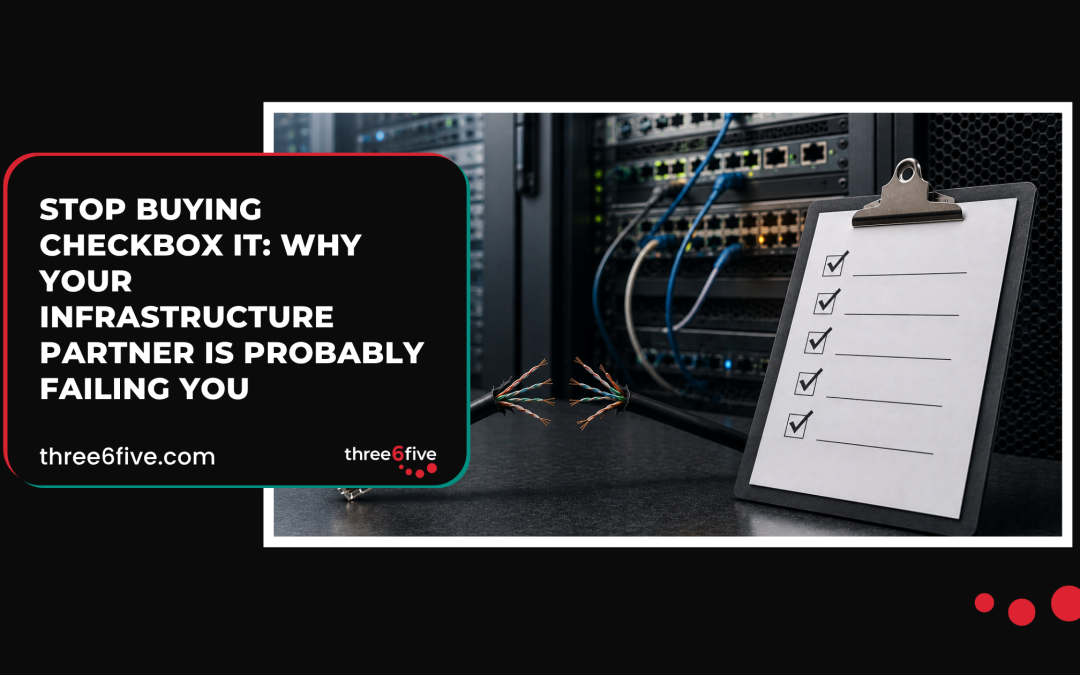
Many organizations make the mistake of selecting a provider based on a “checkbox” feature list:
✓Monitoring included.
✓Firewall management included.
✓Remote support included.
✓Monthly reporting included.
That is neat, tidy, and (unfortunately) insufficient. A feature list tells you what a provider offers; it does not explain how they think.
A robust managed infrastructure services partner should possess the technical acumen to look beyond the hardware. They should be able to identify which sites are most sensitive to latency, which applications exert the most pressure on the network fabric, and where operational bottlenecks are creating hidden risk.
That is the difference between purchasing services and gaining a strategic partner.
Real-World Reality Check: Surviving the Acquisition Avalanche
Let’s talk about what this actually looks like when the stakes are high. We recently took over infrastructure management for the largest cold storage provider in the Southern Hemisphere. This is an aggressively growing business, and with every new acquisition comes a tangled web of complex network and security requirements—usually running on chaotic, inherited legacy equipment.
When strict QA, inventory, and logistics systems are on the line, “checkbox IT” simply doesn’t survive.
For this client, we don’t just blindly support whatever we find. We ensure every newly acquired environment is seamlessly integrated into their managed infrastructure service.
We document it, map it, and make hard, immediate decisions: we either build a strategic roadmap to replace the hardware, or we completely rip and replace it on day one to meet their uncompromising operational standards.
That is what a real infrastructure partner does.
The Warning Signs: Is Your Provider Failing You?
Sometimes the need for a new partner is obvious—strained relationships and poor service. Other times, the signals are subtler:
Operational Uncertainty: If no one can clearly explain the ownership of critical systems, network dependencies, or recent configuration changes, you are operating on guesswork, not strategy.
Recurring Incidents: Every environment has isolated failures. However, if the same links, devices, or applications fail repeatedly, your partner is closing tickets, not solving root causes. That is how support queues start aging like cheese.
Institutional Amnesia: Documentation should not live in someone’s memory. If your partner lacks updated network diagrams, access controls, and change logs, you are carrying massive operational risk. A network diagram from three years ago is not documentation; it is historical fiction.
The “Yes” Trap: A good partner should be helpful, but they should also be honest. If every request is accepted without challenge or design review, risk collects in the background.
The 7-Question Litmus Test for Potential Partners
To cut through the glossy sales proposals, ask questions that force an explanation of their operational discipline:
How do you onboard a new environment?
A credible provider will detail their discovery process—focusing on dependency mapping, asset inventory, and risk identification—not just “getting access.”
How do you maintain documentation?
Demand clarity on how network diagrams, firewall policies, and change records are kept current.
How is infrastructure change controlled?
Look for a structured process for VLAN changes, routing updates, and access policies that emphasizes security and stability.
What is your incident response framework?
Understand the escalation path, communication protocols during outages, and how you receive Root Cause Analysis (RCA).
How do you integrate security?
A modern partner should treat infrastructure and cybersecurity as a single, interdependent entity, not separate silos.
What insights does your reporting reveal?
Reports should show trends, capacity issues, and upcoming lifecycle needs, not just “green ticks” of uptime.
When do you challenge our requests?
You want a partner who can articulate trade-offs and suggest better paths, rather than blindly following instructions that introduce technical debt.
Why Tailored Support Beats “One Size Fits All”
Two companies might have the same number of users, but entirely different risk profiles. One relies on cloud-native SaaS; the other runs complex on-premise systems and strict branch connectivity requirements.
A tailored infrastructure model aligns the support model with your business reality. It ensures that monitoring, project planning, and security controls are adapted to your environment’s specific complexity.
The goal isn’t to create “more IT noise”; it’s to reduce surprises and align technology with business outcomes.
Be cautious of proposals that hide complexity behind low prices, just as you should be wary of those selling everything at once. Poor design decisions, weak change control, and slow escalation paths eventually cost significantly more in productivity losses and remedial project work.
In infrastructure, value is about doing the right things in the right order.
Where three6five Fits In
At three6five, we help South African and global organizations make better infrastructure decisions by combining deep technical expertise with practical, operational support. We design, build, manage, and monitor enterprise-grade network and infrastructure environments.
Our approach is deliberately tailored, not templated. We do not believe infrastructure support should be squeezed into a generic package and handed over with a polite smile and a PDF no one reads twice.
Instead, we start with discovery. We look at the environment, the business priorities, the operational dependencies, the risk areas, and the future roadmap.
From there, we help define what needs support, what needs improvement, what needs tighter control, and what needs proper project planning.
That means our clients get more than technical support. They get a partner who can help them understand their infrastructure, reduce complexity, improve visibility, manage risk, and make better long-term decisions.
We do not just provide “support”; we provide clarity, accountability, and a partnership built around your environment, not someone else’s template.
Frequently Asked Questions (FAQ)
Q: What is a Managed IT Infrastructure Partner?
A: A Managed IT Infrastructure Partner is an external provider that assumes responsibility for the ongoing health, security, and performance of your business’s technology environment. This includes proactive monitoring, network fabric management, cloud connectivity, and long-term lifecycle planning.
Q: How can I tell if my current IT provider is not working out?
A: Common indicators of an ineffective partner include recurring unresolved technical issues, a lack of clear documentation such as network diagrams and change logs, slow or opaque communication during incidents, and a reactive-only support style that fails to suggest proactive improvements.
Q: Why is documentation so vital for infrastructure management?
A: Documentation ensures business continuity. Without accurate records of firewall rules, IP addressing, and device inventories, troubleshooting takes longer, and the risk of catastrophic downtime during a system failure increases significantly.
Q: What makes three6five different from other IT infrastructure companies?
A: three6five combines high-level technical expertise with an operational, discovery-led approach. We focus on building visible infrastructure that reduces risk and complexity, rather than just delivering standardized, generic support packages.
Q: Is a tailored infrastructure support model necessary for small businesses?
A: Yes. Whether your environment is large or small, a tailored model ensures you aren’t paying for unnecessary complexity or, conversely, leaving critical business processes such as backups or security unsupported. Tailored support aligns with your specific risk profile and business goals.
Looking for the right infrastructure partner?
Speak to three6five about a tailored infrastructure partnership built around your business, your environment, and your long-term technology goals.